The ideal and the flesh
The Man Who LaughsThe ideal and the flesh is the novel’s name for a conflict between spiritual devotion and embodied desire, dramatized through Gwynplaine’s love for Dea. Its decisive tension is not simply between two women: Gwynplaine associates Dea with spiritual vision and the Duchess with physical reality, then finds that his love for Dea itself is changing. The contrast tests the purity he attributes to their bond, while the resolution turns on Dea’s presence and Gwynplaine’s choice to burn the Duchess’s letter.
The first division: Dea and the Duchess
Gwynplaine’s first encounter with the idea of embodied womanhood occurs in a dream. Before it, he has known women among the populace as shadows and Dea as a soul; with the Duchess, he believes he has encountered a different reality. The narrative presents her as both woman and Olympian, placing her at once within earthly desire and at an apparently unreachable height. This first vision therefore divides what Gwynplaine has previously held together: the soul he loves is close to him in Dea, while the bodily reality he has newly perceived belongs to a Duchess at an infinite distance.
The contrast is sharpened by Gwynplaine’s recognition that the mystery of sex has been disclosed to him through this distant figure. Dea represents the celestial essence already present in his life; the Duchess represents a terrestrial possibility glimpsed from afar. The arrangement makes the ideal and the flesh feel like separate realms, and makes desire seem to lead away from the person Gwynplaine has loved. Yet his response is not a settled choice between them. The narrative describes two instincts struggling within him, one ideal and one sexual, a conflict that he scarcely understands.
A conflict that passes, then returns
The first struggle ends when Gwynplaine suddenly ceases to think about the unknown woman. The change is inward and gradual enough that he has understood it only dimly, but the narrator makes one point explicit: he has never stopped adoring Dea. The episode is treated as a temporary disorder rather than a replacement of his love. The ideal survives, though it has been tested by an attraction Gwynplaine did not know how to interpret.
Later, after a performance, the conflict reappears in a different form. At midnight, in the meadow near the Green Box on Tarrinzeau Field, Gwynplaine is thinking about Dea, but now recognizes that he is thinking of her as a woman. He reproaches himself, taking this change as a possible failure of respect. The scene marks a threshold in his understanding of their bond: he is no longer merely drawn toward an inaccessible ideal, but is beginning to imagine a future in which love includes earthly and marital feeling. The narrative presents this change as largely unconscious, a transformation that has developed by degrees rather than through a deliberate decision.
Gwynplaine’s new desire unsettles the image of Dea as purely spiritual. He tries to bring her within the conditions of ordinary human life, then feels ashamed of having done so. The important conflict is therefore not that he ceases to love her, but that love’s ideal form can no longer contain all that he feels. He resists the change, and it recurs; the narration describes his affection as passing through a crisis in which the ideal is at risk. His devotion becomes nuptial, bringing the spiritual attachment and earthly desire into one relationship, though not without anxiety about what that transformation means.
Dea’s presence and the Duchess’s letter
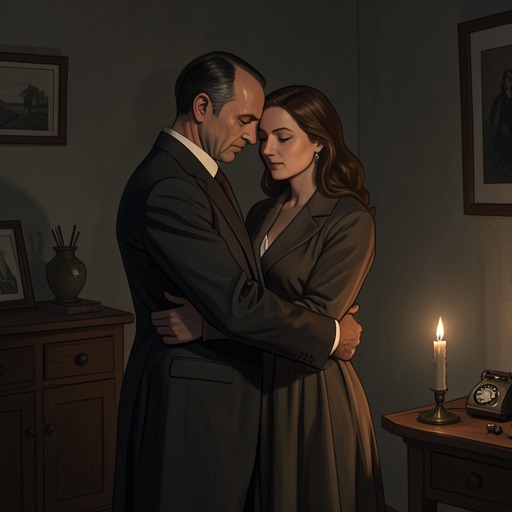
The tension reaches a crisis during a sleepless night when Gwynplaine is troubled by the Duchess’s letter. At daybreak, with Ursus already risen, he remains absorbed in the letter and in the turmoil of his thoughts. Dea appears at the half-open doorway and asks whether he is asleep. Her presence changes the scene: the storm within him subsides, and the narrative figures her as a source of light that disperses his inward darkness. She does not argue him out of his conflict; simply seeing her restores the moral clarity he had lost.
Gwynplaine then burns the Duchess’s letter. The action gives his resolution a concrete form: instead of continuing to hold the letter as an unresolved invitation or temptation, he destroys it and experiences relief. The narrative connects that relief with renewed integrity, as though the temptation had vanished with the smoke. The episode does not establish that desire itself has disappeared. Rather, it shows Gwynplaine choosing the relationship he has with Dea over the alternative represented by the Duchess’s letter, and finding that choice consonant with the person he wishes to be.
Afterward, Gwynplaine and Dea share cups and talk together. Their quiet, affectionate exchange follows the inward upheaval and the burning of the letter. In the sequence, ordinary companionship becomes the scene’s evidence of restored closeness: the resolution is not a grand declaration but a return to the two of them together. The ideal is no longer only a distant spiritual principle; it is renewed through Gwynplaine’s care for the person beside him.
Meaning and limits of the resolution
The novel frames the ideal and the flesh as opposed instincts, but it also shows their separation becoming unstable. The Duchess first exposes the bodily realm as something Gwynplaine has not known; later, his desire for a married life with Dea brings that same realm into the love he had treated as purely spiritual. His shame reveals how strongly he has divided the two, while the narrative’s account of love’s development suggests that the division cannot simply be maintained. Dea remains the object of his adoration even as his understanding of her changes.
The resolution is ethical as well as emotional. Gwynplaine’s temptation is linked to a letter he can burn, and his return to integrity is associated with Dea’s presence and the bond between them. Yet the episode offers no claim that inward conflict is permanently abolished: earlier, Gwynplaine’s thoughts of the unknown woman had ceased, only for the conflict between ideal and desire to take a new form. The concept thus describes a recurring strain in his emotional life, not a single temptation conclusively overcome. Its narrative importance lies in making love’s transformation visible: devotion may begin by placing the beloved above earthly life, but Gwynplaine must confront what happens when that idealized love becomes human, intimate, and directed toward a shared future.